

Modern Alchemy
Transmuting materials into scarce capabilities

We do not have enough power.
The U.S. is not adding electricity generation capacity as fast as demand for it is growing on the back of the AI revolution. If generation is not the lever available to us in the near term, we must ensure that efficiency is. America wins by getting more compute, more industrial output, more strategic capability out every existing watt we already have today. Efficiency doesn’t make the power problem go away (see Jevon’s paradox), however, It’s probably the only realistic strategy available today.
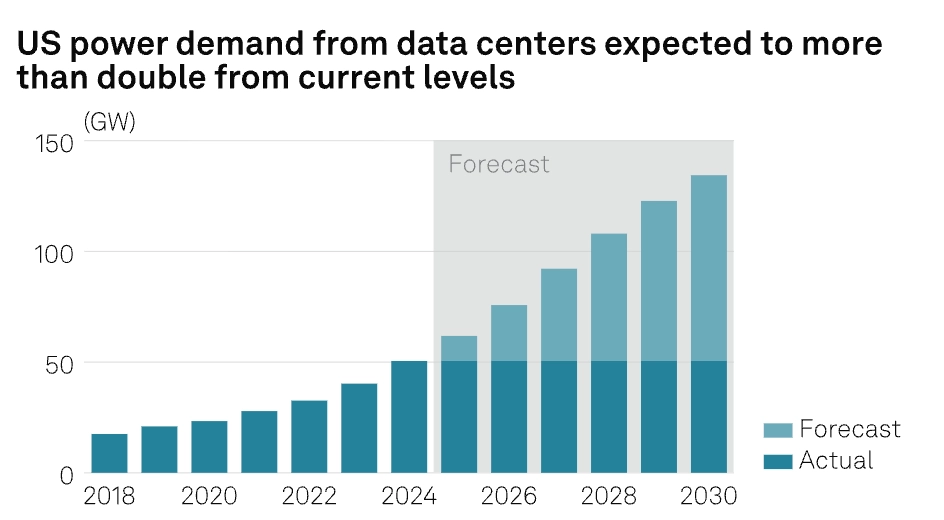
We believe there is a massive opportunity to invest behind ROEI - return on energy inputs: the useful output a process delivers per unit of energy it consumes, measured against the legacy process being replaced. A higher ROEI can come by doing the same job for less energy, or doing a job the incumbent process can’t possibly do without breaking. Either way, it is more capability per watt, and the watt is the constraint governing everything underneath it from training runs to inference capacity to domestic chemical production to the hardware buildout supporting this new industrial revolution.
Venture has absolutely lived in the bit economy for the last decade, but atoms-based investing has become consensus since 2022 (see SpaceX, Anduril, etc.). Yet all of the attention is chasing the visible layer from launch vehicles to automated factories to robotics. The constraint underneath every one of them is energy, and the return generated on each unit of it.
We will solve for current and future power constraints with Modern Alchemy, transmuting novel inputs into scarce capabilities with a high ROEI.
Alchemy as Statecraft
Alchemists have historically been thought of as mystics attempting to turn lead into gold. Yet many early modern rulers supported alchemical, metallurgical, and artisanal research in pursuit of wealth, military capability, and supply chain independence.
In 1701, Augustus the Strong (of Saxony and King of Poland) imprisoned alchemist Johann Friedrich Böttger to force him to turn base metals into gold to solve for the Saxon debt crisis. Instead of creating gold, Böttger instead invented European porcelain, breaking East Asia’s monopoly on a valuable trade good and creating massive wealth. The King wanted gold. Instead he got industrial chemistry.

Lessons of statecraft can be found in the twentieth century as well: Chile had a monopoly on saltpeter (sodium nitrate mined from the Atacama desert), the dual-use nitrogen source for fertilizer and energetics, until Germany broke it with industrial chemistry via the Haber-Bosch process. When WWI broke out and the British Navy enforced a maritime blockade, Germany was cut off from Chilean saltpeter. Without this alchemy, Germany likely would have run out of gunpowder within months.
Drop-In Transmutation as the Pattern
We organically went down this rabbit hole of modern alchemy through three distinct areas, the compute bottleneck, the missing middle in chemistry, and abundant-element alternatives to rare earths. While these seem adjacent on the surface, they are one pattern.
We have been looking for companies that substitute cheaper synthesis (from an ROEI perspective) for a legacy process — photons for electrons, aqueous flow for the arc furnace, engineered abundant elements in lieu of scarce ones that are mined — while remaining compatible with the industrial interface the world consumes. In photonics for example, this means being CMOS-compatible, plugging directly into TSMC’s and other existing foundry flows rather than creating an entirely new fab paradigm.
Drop-In transmutation is not a stylistic preference but instead a capex argument with the ROEI framework in mind given compatibility collapses the capital requirement + time to revenue.
Why Now
There are three converging forces acting as a mega catalyst for Modern Alchemy.
Physical: Power will be the gating resource for AI cluster buildouts as frontier chips require greater power density (e.g., Nvidia’s next class of Vera Rubin chips doubles the per-chip power draw of the Blackwell).
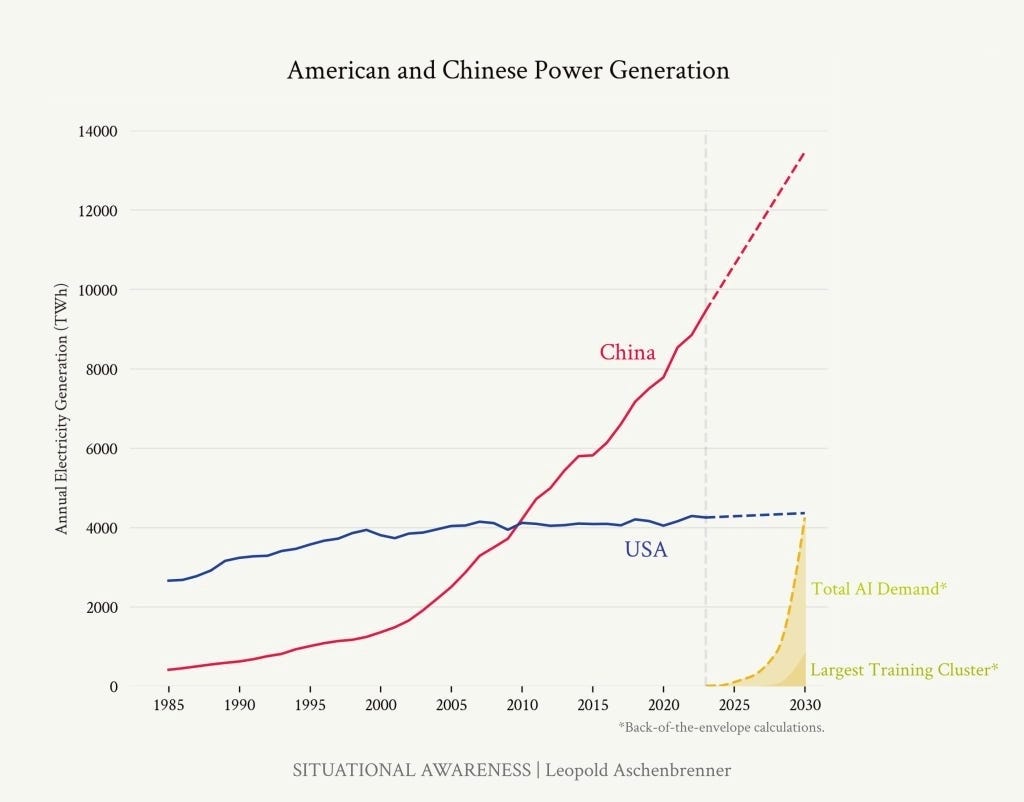
Geopolitical: Since 2023, China has weaponized its process monopolies with export controls on gallium germanium, graphite, antimony, and rare earths. For the AI buildout, China already generates more than 2x as much electricity as the US, and they are expected to continue to build that lead (Leopold hasn’t been wrong just yet).
Fiscal: Reshoring capital has become real for the first time in a generation: defense energetics demand, industrial policy, and strategic buyers willingness to pay.
The Compute Bottleneck
Through our work hypothesizing where value will accrue in The Model Economy, we mapped power limits on scaling AI clusters for training as well as the inference proliferation that follows.
The key catalyst is that frontier AI racks are going from tens of kilowatts to hundreds in a handful of years, and Nvidia’s chip roadmap now points to a MW per rack.
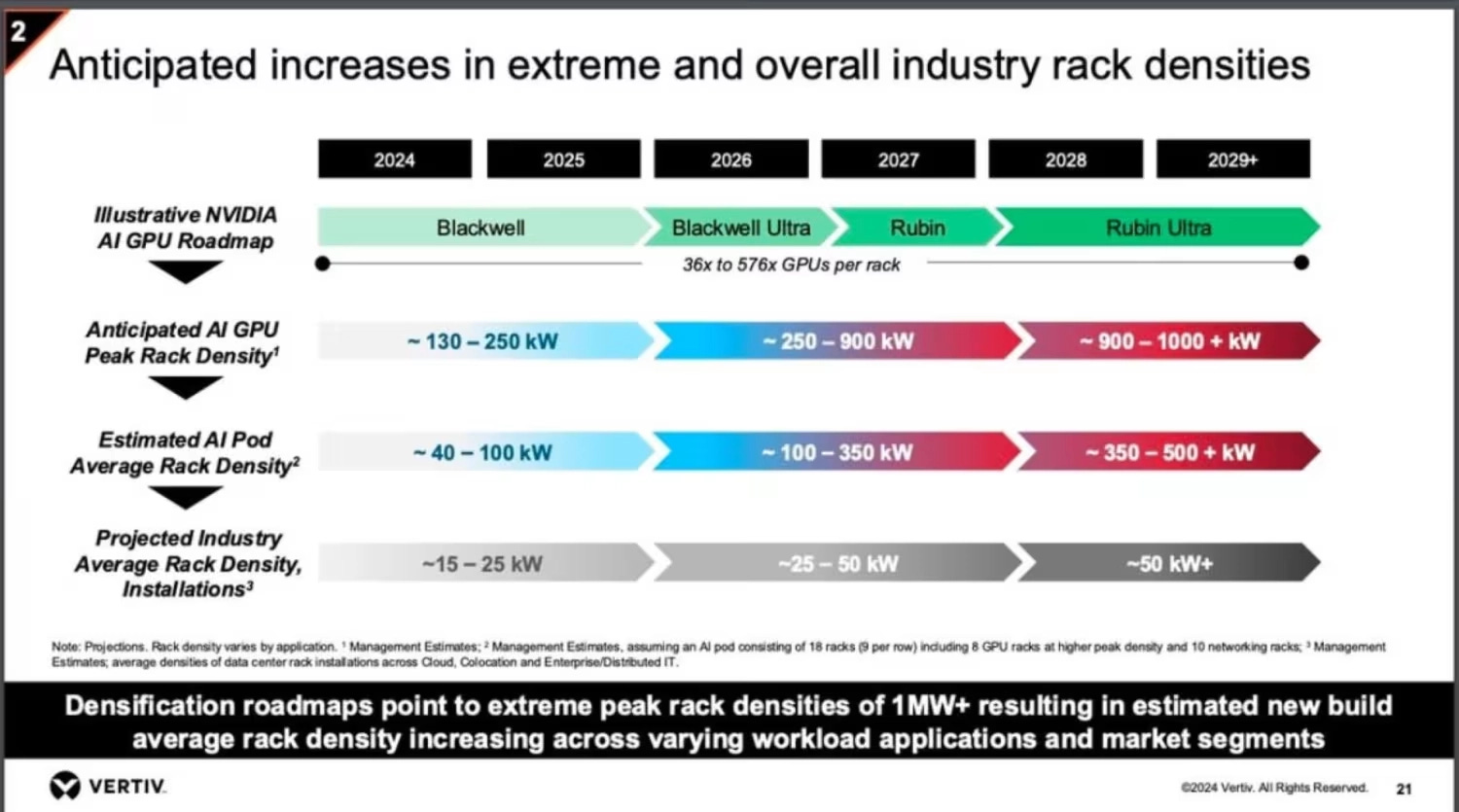
At this level of power density (the power level will indeed be over 9000), the incumbent materials in data centers will break. Copper interconnects are already hitting walls in bandwidth and energy per bit. Traditional lithium-ion batteries, while falling price over the 30 years, cannot buffer loads that spike to many times their average draw in milliseconds, degrading the actual chemistry of the batteries much faster than expected. These constraints require innovation in material science at each layer, from data transfer to energy storage to heat dissipation.
Photonics is where we have gone deepest, replacing electrical signals with light in the movement of data (i.e., between chips) and improving ROEI by an order of magnitude. This is not a venture insight of itself, photonics exposure can be had in the public markets via Coherent, Lumentum, Broadcom, and others working on photonic processors for AI.
Where lies the venture opportunity then in photonics?
New materials (i.e., silicon carbide, superconducting tapes) that allow us to underwrite the size of the discontinuity beyond the trend itself
Looking beyond the current AI bottleneck and focusing on compute bottlenecks in edge areas (i.e., cryogenic computing environments, quantum)
The Missing Middle in Chemistry
What if I told you that 100% of a critical material of the U.S.’s defense energetics, pharmaceuticals, and even consumer supplements like creatine are imported? Run entirely through a fragile, century-old supply chain dominated by China as the only producer at scale via a massively energy-intensive process? That is the state we are in, with an infrequently mentioned material in cyanamide and its derivatives.
Without the same power abundance as China, it would be impossible to reshore the manufacturing of these materials with the same arc-furnace process. We thus have been very interested in new manufacturing methodologies (i.e., continuous flow, aqueous routes, etc.) that deliver a high enough ROEI to make it painfully obvious to reshore this production — delivering the same materials within a vetted supply chain without the risk of foreign tampering, for a cheaper price, and with a cleaner footprint.
Abundant, Not Rare, Earths
Try to build almost anything clean and you hit the same wall: rare earth elements and platinum group metals. It’s a strange paradox — green tech is sold to us as sustainable, but the extraction behind it is toxic, insanely energy-intensive, and basically all controlled by China at the processing step. Some investors are chasing this problem all the way to asteroid mining, which is a fun thing to put in a pitch deck but not something we think pencils out anytime soon. We’d rather bet on chemistry we can do here, now, on the ground.
What we find interesting is nanoscale material synthesis — founders who’ve stopped asking “how do we get more of these metals” and started asking “do we actually need the metal, or just what it does.” Platinum and iridium earn their price because of specific catalytic and conductive properties, not because platinum and iridium are magic. If you can engineer an abundant, first-row element at the nanoscale to do the same job, you don’t need the mine. The reactors running this work are low-temperature (under 100°C) and continuous-flow — no smelting, no toxic extraction, a fraction of the capex, and an ROEI curve mined incumbents simply can’t touch. This is probably the most literal alchemy in the whole thesis: cheap elements engineered into something that behaves like a scarce one. It’s also our earliest area — the right teams are still rare — so for now we’re mostly just staying close, waiting for the formation conversation worth having.
Centuries ago, the sovereign rulers who funded alchemists were wrong about the mechanism but still got the prize: whoever is able to master material transformation can unlock power. The lesson of Böttger and others like Frank-Caro is that the failed transmutations and the boring molecules can lead to empire building. We at Worldbuild are excited to back Commercial Scientists doing that work now, leveraging breakthrough materials and novel methodologies to their advantage.
If you had to bet on one breakthrough over the next decade, which would you choose: new battery chemistry, photonics, advanced materials, or something else , and why?
Interesting